| Measure | Value and condition | Planning use |
|---|---|---|
| Craving relief window | Cravings and withdrawal symptoms decrease during exercise and for up to 50 minutes afterward | Schedule a walk just before a known trigger and expect relief to carry past the end of the session. |
| Short bouts | Even short periods of activity, especially aerobic exercise, reduce the urge to smoke; 10 minutes three times a day gives the same benefits as 30 minutes of non-stop exercise | Place short sessions around your hardest cravings instead of waiting for a long free slot. |
| Weekly activity target | 30 minutes of physical activity most days of the week | Use this as the working target once short bouts feel routine. |
| Typical weight change | On average, 5 to 10 pounds (2.27 to 4.54 kilograms) in the months after quitting | Plan food and movement from the start of the quit rather than reacting after the scale moves. |
| Nicotine and calories | Nicotine increases the calories the body uses at rest by about 7% to 15% | Explains why appetite and metabolism shift after quitting and why food planning matters. |
These figures come from Smokefree.gov’s guidance on fighting cravings with exercise and MedlinePlus patient instructions on weight gain after quitting.
Exercise to help quit smoking works best as short, regular aerobic sessions used when cravings hit, backed by planned snacks so hunger does not drive weight gain. Start small and build from there.
This guide covers how movement changes cravings, which cardio routines suit a new ex-smoker, what lung recovery can realistically mean, and how to eat so that quitting does not turn into a second struggle. If weight is your main worry, the dedicated guide to weight gain after quitting smoking goes deeper on the numbers.
Where exercise fits in a quit plan
Exercise earns its place in a quit plan because it acts on cravings directly and on the appetite changes that often follow. It is a tool you can use in the minutes when a craving peaks, not only a long-term fitness project.
Craving relief during and after a session
Smokefree.gov, the US government’s quit resource, reports that withdrawal symptoms and cravings for cigarettes decrease during exercise and up to 50 minutes after exercising. That window shapes how you should use a workout. A walk that ends at the moment a craving would have started gives you less cover than a walk that begins shortly before your usual trigger and finishes after it has passed.
The practical reading is to link movement to your known trigger times. If you smoked with morning coffee, after meals or on a work break, move your activity into that slot. You are not trying to burn off the craving by exhaustion. You are placing a stretch of relief across the period when it would otherwise be strongest.
Short bouts count
The same Smokefree.gov page states that studies show even short periods of physical activity, especially aerobic exercise, reduce the urge to smoke. This matters most in the first days of quitting, when a full workout may feel out of reach. A brisk lap of the block is a legitimate craving response, not a lesser version of exercise.
Short bouts also solve a scheduling problem. Because several brief sessions through the day match the benefits of a single continuous session, you can aim sessions at your three or four hardest craving points instead of finding a single block of free time. If your day is unpredictable, this is the more reliable plan.
What counts as aerobic activity
Smokefree.gov defines aerobic exercise as physical activity that makes you sweat, causes you to breathe harder and gets your heart beating faster. It lists walking, swimming, running, dancing, cycling and boxing as examples. That range is useful, because the best choice is the one you will do on a bad craving day. Someone with a dog may choose walking, someone near a pool may choose swimming, and someone who dislikes formal workouts may find dancing at home easier to start.
MedlinePlus adds a second benefit that fits this guide’s food focus: physical activity helps you burn calories and can also help you ward off cravings for unhealthy foods or cigarettes. One habit therefore covers both the cigarette craving and the snack craving that often replaces it.
Cardio routines for new ex-smokers
The best starter routine is brisk walking built up gradually, with running, treadmill work or other cardio added only when walking feels comfortable. Cardio exercise is the activity type that most directly serves quitting, since it is the type that research on cravings points to.
Brisk walking as the default
The American Lung Association lists walking briskly among its examples of moderate activity, alongside recreational bicycling, gardening and vigorous housecleaning. That last pair is a useful reminder for people who feel they have no time to exercise: household effort that raises your breathing can count as moderate activity.
Brisk walking suits most beginners because it needs no equipment, can be broken into short bouts and can be repeated daily without much recovery time. The guide Cardio for Beginners: Simple, Safe Workouts to Boost Fitness Fast (2026) – Canstopsmoking lays out simple routines for readers who want a plan rather than a general instruction to move more.
Treadmill and incline options
Weather and darkness can undermine an outdoor plan, and a craving does not wait for good conditions. A treadmill gives you a fixed place to go when the urge arrives. The Beginner Treadmill Walking Workout: A 4-Week Plan To Build Fitness And Burn Calories – Canstopsmoking is a structured option for indoor walking.
Once flat walking feels easy, raising the gradient is one way to increase effort without moving faster. The article Incline Walking: 7 Surprising Health And Fitness Benefits Backed By Science (2026 Guide) – Canstopsmoking explains what that change involves. Choose this route if you want more challenge but are not ready for running.
Running and variety
Running appears on the Smokefree.gov list of aerobic activities, and it suits people who already walk comfortably and want a stronger workout. Treat it as a later step, not a starting point, particularly if breathlessness is still a daily limitation. The plan Start Running: An 8-Week Beginner’s Guide To Build Confidence And Endurance In 2026 – Canstopsmoking is built for people beginning from low fitness.
For readers who get bored with a single route, walking surfaces and styles can be varied. The piece Barefoot Walking: 7 Science-Backed Benefits For Health, Mood, And Mobility – Canstopsmoking covers one alternative worth knowing about before you change how you walk.
Setting weekly targets
Published targets differ because they serve different goals, so match the figure to your reason for exercising.
- For craving control: Smokefree.gov suggests aiming for 30 minutes of physical activity most days of the week.
- For general adult health: the American Lung Association says national guidelines recommend that all adults get 30 minutes of moderate physical activity five days a week.
- For limiting weight gain: Rutgers Cooperative Extension suggests walking or other aerobic exercise for 150 to 300 minutes per week.
- For a stronger push: Nationwide Children’s Hospital advises at least 30 to 60 minutes on most days of the week for people holding their weight after quitting.
These are targets to grow toward, not entry requirements. Nationwide Children’s recommends starting with 10 minutes at a time if 30 minutes feels like too much. A sensible order is short bouts first, then the 30-minute habit, then the longer weekly totals only if weight management is a priority for you.
Lungs and breathing practice
Aerobic fitness and breathing practice both improve how comfortable breathing feels, and the evidence supports expecting gradual change rather than a quick reset. Lung function and lung capacity are the measures many ex-smokers worry about, and exercise is one of the few things you control that supports them.
What regular cardio does for breathing
The American Lung Association explains that just as regular exercise makes muscles stronger, it also makes your lungs and heart stronger. It adds that as physical fitness improves, the body becomes more efficient at getting oxygen into the bloodstream, which reduces breathlessness during exercise. The practical signal to watch is not a number but how an effort that used to leave you gasping feels after a few weeks of regular walking.
No supplied evidence promises a timeline or a specific lung capacity figure, so measure progress by what you can do. Can you finish your usual route while still able to speak? Can you climb stairs more comfortably? Those everyday checks tell you more than any date on a calendar.
Breathing exercises
The same American Lung Association page notes that breathing exercises in particular can strengthen the diaphragm and train the body to breathe more deeply. They fit well alongside walking, since they can be done anywhere, including in the middle of a craving when you cannot get outside. For step-by-step practice, see Breathe Better: Practical Lung Exercises To Improve Capacity, Ease Breathlessness, And Boost Recovery – Canstopsmoking.
If you prefer slow, structured movement that combines posture and breath, the guide to yoga to quit smoking examines poses and the evidence behind them. Choose breathing work or yoga as a complement to cardio, not a replacement, because the craving-relief research specifically highlights aerobic exercise.
Weight after quitting
Weight gain after quitting is common but not fixed, and exercise plus regular eating is the most direct way to limit it. Understanding the cause helps you pick the right response.
Why weight shifts
MedlinePlus states that on average people gain 5 to 10 pounds (2.27 to 4.54 kilograms) in the months after they give up smoking. It also explains part of the cause: nicotine increases the amount of calories your body uses at rest by about 7% to 15%, so removing it can slow metabolism. The average is a planning figure, not a prediction for any one person. Your own change will depend on how your eating and activity respond.
This is a modest trade for most people, but it is a trade worth managing. The aim is to protect your quit first and keep weight steady second, and the two goals support each other when movement and food are planned together.
Using exercise and meals together
Smokefree.gov says exercise decreases appetite and helps limit the weight gain some people have when they quit smoking. The wording is deliberately modest, and so should your expectations: exercise limits gain for some people, and it does not erase it.
- Move on the same schedule as your cravings: a walk at a trigger time reduces both the smoking urge and the urge to snack.
- Do not let yourself get too hungry: MedlinePlus advises never getting too hungry, because extreme hunger makes unplanned eating more likely.
- Keep snacks ready: a planned crunchy option is easier to choose than a vending machine when a craving is loud.
- Raise your weekly activity gradually: the higher weekly aerobic ranges suit people who want to actively manage weight, not everyone in the first weeks.
For a week-by-week approach, the plan How To Quit Smoking Without Gaining Weight: A Practical 8-Week Plan – Canstopsmoking combines the same ideas into a schedule.
Food and snacks for oral cravings
When quitting, the question of what to eat is mostly about replacing the hand-to-mouth habit with something low in calories and satisfying to chew. Healthy snacks work best when they are crunchy, visible and ready before the craving arrives.
Crunchy swaps that fit the habit
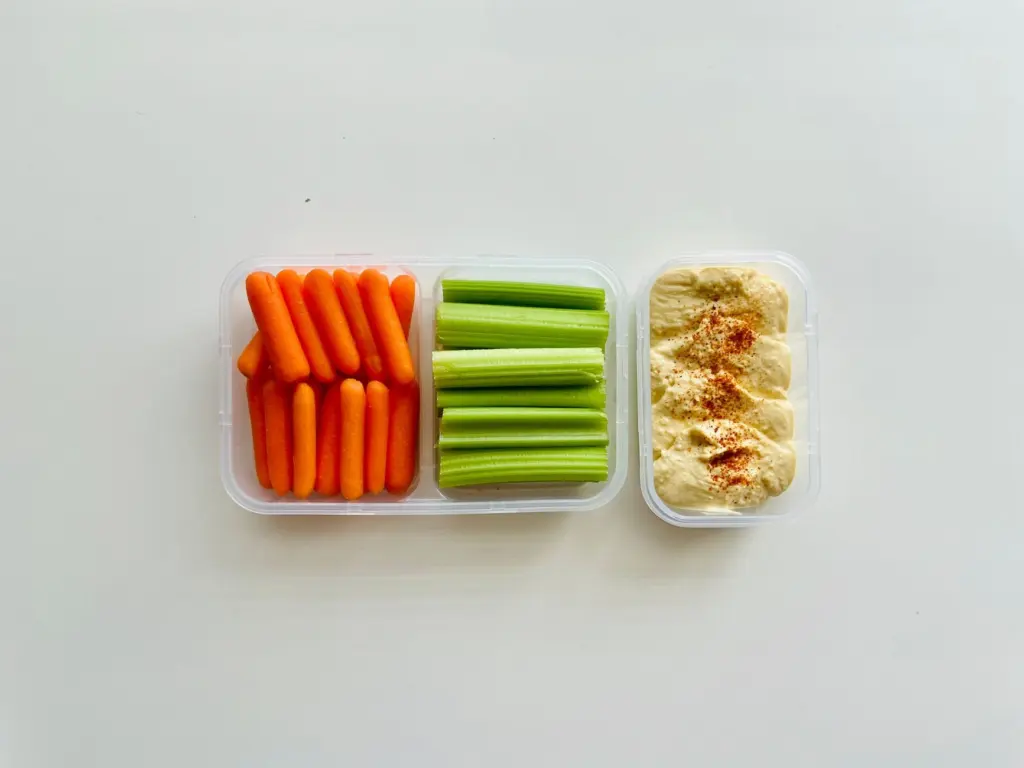
Rutgers Cooperative Extension says that crispy fresh vegetables with lots of crunch that are healthy and low in calories will help to satisfy cravings. Nationwide Children’s Hospital names specific options: carrot sticks, celery sticks, raisins, apples and grapes. The table below compares how to use them.
| Option | What the guidance says | Planning use |
|---|---|---|
| Carrot and celery sticks | Named as lower-calorie choices for the oral habit; fresh, crunchy vegetables help satisfy cravings | Best everyday default: prepare them in advance and keep them where cigarettes used to be. |
| Apples and grapes | Named as lower-calorie choices | Suit people who want something sweet without moving to sweets. |
| Raisins | Named as a lower-calorie choice | Portable and easy to carry, though a small handful is the sensible unit. |
| Gum and hard candy | Could be high in calories and sugar | Check labels before relying on them, because they can add up without feeling like a snack. |
The options come from Nationwide Children’s Hospital’s advice on maintaining weight after quitting and Rutgers Cooperative Extension’s quitting factsheet.
The choice depends on what your hands and mouth miss. If you want something to bite, pick vegetables. If you want something sweet, fruit is the better first move. Raisins and grapes are easy to carry, but they are the options where portion discipline matters most.
Between meals and late at night
The hardest eating moments are often the same as the hardest smoking moments: after dinner, in front of a screen, late in the evening. Planning for those slots matters more than choosing a perfect snack. For ideas, the guide to what to snack on when quitting smoking focuses on oral cravings, while Low-Calorie Late‑Night Snacks: 20 Satisfying Picks That Won’t Ruin Your Sleep Or Diet – Canstopsmoking addresses evenings specifically.
If you want snacks that leave you feeling full, Feel Full, Eat Less: 17 High-Volume, Low-Calorie Snacks Backed By Science (2026 Picks) – Canstopsmoking is the relevant read. For readers who track carbohydrates, Low‑Carb, Low‑Calorie Snacks That Keep You Full — 2026 Guide To Smart, Satisfying Choices – Canstopsmoking covers that angle. Pick one of these guides to match your eating pattern instead of reading them all at once.
Food first, supplements second
Everyday food choices do most of the work in the first weeks, and most of the questions around nutrition come back to meals and snacks. If you are wondering whether pills belong in your routine, vitamins for ex smokers separates what is worth considering from what to skip, so you can decide after the basics are in place.
Staying consistent
Consistency comes from making the routine small enough to repeat on a bad day, and from noticing that activity tends to get easier after quitting. Nationwide Children’s Hospital observes that now that you have stopped smoking, physical activity may be easier and more enjoyable. That is a reason to retest an activity you gave up when smoking made it uncomfortable.
A starting sequence
- Pick one aerobic activity from the Smokefree.gov list that you can do at home or near it.
- Attach it to a trigger. Choose your most reliable craving time and move just before it.
- Keep sessions short at first. Begin with 10 minutes if 30 feels like too much, as Nationwide Children’s advises.
- Add a planned snack. Keep a crunchy option ready so the post-walk hunger has an easy answer.
- Build toward the target. Move toward 30 minutes of activity most days once short sessions are routine.
When motivation drops
Motivation dips are expected, especially when cravings and fatigue arrive together. Rather than waiting to feel like it, reduce the task: a short bout still counts for craving relief. The article How To Stay Motivated During Workouts: 10 Practical Strategies To Keep Going In 2026 – Canstopsmoking collects strategies for exactly this stage.
Frequently asked questions
Do I need to see a doctor before I start exercising?
The American Lung Association advises talking to your doctor before you start or modify your exercise routine, and that matters most if you have an underlying health condition. Read its exercise and lung health guidance alongside your doctor’s advice.
Is chewing gum a good substitute for smoking?
Sugar-free gum can keep your mouth busy without adding calories, according to MedlinePlus. Regular gum and hard candy may be high in calories and sugar, so read the label.
Will I definitely gain weight after I quit?
No. Rutgers Cooperative Extension says quitting nicotine products does not mean you will gain weight, although it could. Your own result depends on factors such as activity and eating habits.
Does drinking water help with snacking?
It can. Rutgers recommends drinking water throughout the day, and Nationwide Children’s suggests drinking water when you are tempted to eat between meals because hunger can be mistaken for thirst. See the Nationwide Children’s guidance.